
THE
AFRICAN ANIMALS

Chapman's Zebra
They have been called horses in striped pyjamas. Orana's species are not considered endangered, however several Zebra species are rare and one, the Quagga, is already extinct.

Although different species of Zebra have their own distinctive markings, no two zebra within these groups are identical; in fact their markings are unique and identifiable, like human fingerprints.

Rothschild's Giraffes
Our
Rothschild's Giraffes are perhaps the most popular of all our animals. Male Rothschilds Giraffes are easily identified because they possess three horns rather than two found in the other eight subspecies.

Giraffes have few enemies. They can run at up to 56 kph, sufficient to outrun most predators. They live on average 20 to 28 years.

Wild Dog
Once widely distributed throughout Africa, the Wild dog is now one of the most endangered animals in that continent.

They are also known as Cape Hunting Dogs and African Hunting Dogs. They live a nomadic existence, a group typically being 4-10 adults. A captive breeding scheme for these animals commenced in Australasia in the mid 1960s.

Cheetahs
These cats are another Orana Park success story. Extremely threatened in the wild, their survival may well depend upon the captive breeding schemes and Orana Wildlife Park is part of the Global network dedicated to their recovery.
Meerkats
Meerkats
are highly sociable members of the mongoose family. They live in large family groups of up to 30 animals and do most things communally, including hunting, raising the young and taking turns at guard duty. They have acute eyesight and a highly developed sense of smell.

Lions
Orana Wildlife Park Lions are well known locally. Their roars can be heard for miles. Lions are the only cats which live in social groups called prides. In the wild a lion can live up to 15 years but in captivity it may live for up to 25 years.

Southern White Rhinoceros
At one time there were only around 30 left in the wild but with the establishment of game reserves, anti-poaching patrols and captive breeding programmes the outlook has improved markedly.

Orana Wildlife Park is part of an international White Rhino breeding program. White Rhinos generally live together in small family groups. Despite their size they can move quickly and speeds up to 40 kph have been recorded.

Although the Rhino's sight is poor, its hearing is excellent. Its skin is mainly coarse and leathery, yet in the folds it is as soft as chamois.

Sable Antelope
These are amongst the most elegant of African antelope. During the breeding season, males with territories maintain harems of 10 to 20 females.

Like most of Africa's mega mammal fauna, Sable Antelope are threatened by habitat loss and poaching.

Ringtailed + Black & White Ruffled Lemurs
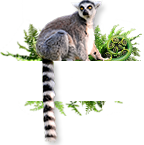
Lemurs are primitive primates, all of which are native to Madagascar. Orana Wildlife Park has two species, the Ringtailed and the Black and White Ruffled Lemurs.

Lemurs have no real predators other than man, but are considered endangered because of loss of habitat through forest clearing.

Scimitar-horned Oryx
These animals epitomise what the original trustees of Orana Wildlife Park envisioned when they founded the Wildlife Trust. Highly endangered, the Oryx have flourished under favourable Canterbury conditions and have bred prolifically. Offspring have been sent to many parts of the world to help other breeding centres.

Early explorer reports suggest that the population then numbered in the hundreds of thousands. With the advent of modern guns and off road vehicles they fell easy prey to hunters and by the 1950's there were only a few thousand left. In mid 1984 civil war in Chad eliminated the last of the wild population.

Orana Wildlife Park is part of a worldwide breeding programme. Since 1978 Orana Wildlife Park has made a highly significant contribution, with more than 50 animals bred. Orana Wildlife Park was the first institution to breed Scimitar-horned Oryx by artificial insemination.


Ostriches
Being the largest of the living birds, a male may stand 2.5 metres tall and control a harem of up to three females.

New Zealanders can only look at the Ostriches, wonder if our Moas were similar and remind ourselves that extinction is forever.

Crested Porcupine
The Park has three species of animal in the Kopje exhibits. The Crested Porcupine is the largest and spiniest of these rodents and are in no way related to the hedgehog.

These animals can live up to 15 years of age and weigh up to 24 kgs.

Greek Tortoise
Contrary to its name is found in many places other than Greece. Highly popular in Britian and elsewhere as a pet.

It is a hardy and robust animal, found throughout the eastern Mediterranean and into northern Africa.

Addra Gazelle
Frequents habitat similar to, but slightly less marginal than that occupied by the Oryx.

Addras live in small herds of up to 15 animals. It is estimated that fewer than 500 animals live in the wild, most of them in a fauna reserve in central Chad. We have successfully bred Addras at Orana Wildlife Park.

Eastern Waterbuck
These
are found throughout most of Africa, usually in conjunction with water.

They are excellent swimmers and will take to water to avoid potential danger.

Springbok
Gregarious creatures living in herds of up to 1500, forming part of the huge mixed herds that migrate across the African plains looking for fresh growth.

When alarmed or excited, they will bound straight up into the air reaching heights of up to 3.5 metres.

www.oranawildlifepark.co.nz
Copyright © 2003 - Orana Wildlife Trust