THE
NEW ZEALAND ANIMALS

Kiwi
Like most of New Zealand's native fauna, kiwi are under constant threat, especially from introduced mammals. It is feared that when the current generation of adults dies out in about 20 years, Kiwi may become extinct because there may not be enough young survivors to replace them.

Kiwi are flightless and nocturnal, with nostrils at the tip of the beak which is used as a probe to find insects. Although their sight is poor, they have an excellent sense of smell. Breeding is from June to March. The male incubates the egg for 72 days. On hatching the young are totally independent of their parents. Residual yoke gives the chick up to a month's food supply.

Tuatara
These are often been called a "living fossil", as its dinosaur relatives died out elsewhere in the world at least 60 million years ago. Tuatara are among the most primitive living reptiles, having undergone few evolutionary changes in anatomy during the past 200 million years. Biologists classify the tuatara in an Order of its own with equal rank to the turtles, crocodilians, lizards and snakes.

Males have a better developed crest and are usually larger than the females. Once common on the mainland, tuatara are restricted to offshore islands, most notably Stephens Island (Takapourewa), where their population numbers in the tens of thousands.

Through a Department of Conservation recovery scheme, captive-bred tuatara from Orana Wildlife Park have been released onto Red Mercury Island.

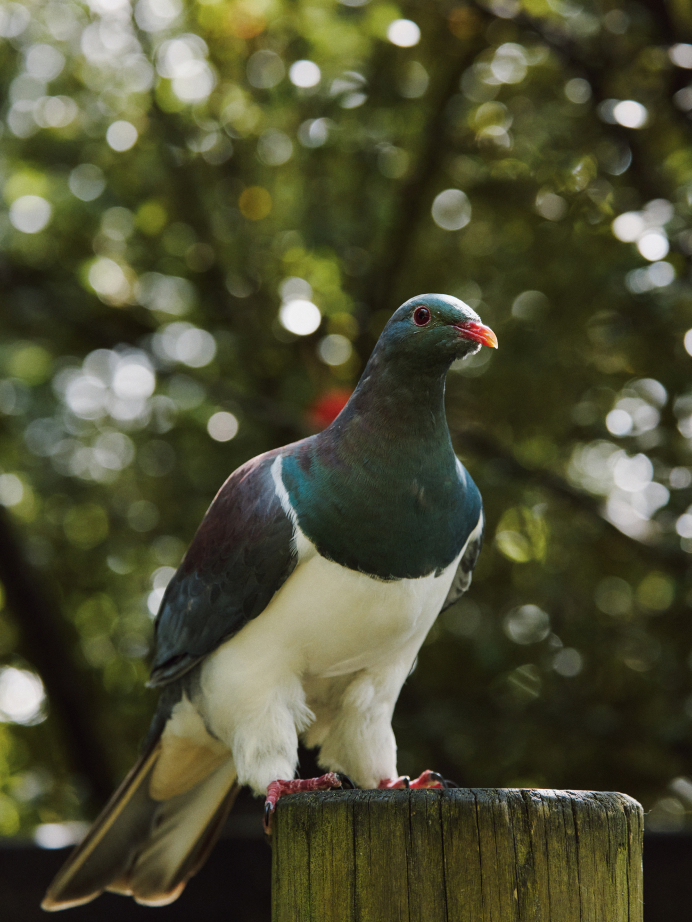
Kereru (Wood pigeon)
These birds suffered by being large, easy to catch, and good to eat. The species is endangered and is now protected.

Our Kereru include several which have recovered from close encounters with traffic.

Kakariki (Red & Yellow-crowned parakeets)
Red-crowned parakeets are closely related to the yellow-crowned and this is reflected in the same Maori name, Kakariki, for both species. Red-crowned parakeets are now restricted to a number of offshore islands.

They live in small flocks in the native forests of both islands, where they forage for berries, shoots and seeds. During early European settlement they proved fond of orchards, where they inflicted considerable damage. Sadly kakariki have suffered severely from predation.

Breeding sanctuaries, such as Orana Wildlife Park, provide additional genetic security for the species as well as a venue where the public can view our diminishing natural heritage and hopefully become more enthusiastic about assisting the efforts to conserve this.

Kea
These intelligent, inquisitive and comic birds scavenge around human settlements in the Southern Alps. Kea once had a bounty on their heads, as they will occasionally attack live sheep for the fat around the kidneys.

The bird is still recovering from this bounty slaughter even though it is now protected. They are known to live for up to 15 years and are normally three years old before they breed, when the kea pair will hatch two or three chicks in a nest of lichen, twigs and leaves. The kea is one of the few parrot species that is at home in the snow.

New Zealand Kingfisher
New Zealand Kingfishers are common and widespread on the Kermadecs, North, South and Stewart Islands and most offshore islands, but not the Chathams or subantarctic Islands . They are less common inland and in the Southern South Island .

They occupy many habitats, especially bush patches near the coast, tidal estuaries, mangrove swamps in the north and developed farmland. Although Kingfishers occasionally live deep in forests, they have probably benefited from the clearance of forests, the creation of forest-edge habitats and riparian margins of willows and poplars along rivers and near lakes. They are usually solitary or in pairs, spaced widely apart when breeding or feeding. They often perch for long periods on any elevated object such as a rock, post, powerline, driftwood or bare branch, especially those that overlook pasture or tidal mudflats.

They nest in a chamber at the end of a tunnel.  To start a tunnel, kingfishers fly straight towards the spot at full speed with their neck outstretched and uttering a peculiar sound, hitting the mark forcefully with their sharp bill!


Photo : Geoff Moon
New Zealand Scaup
These are self introduced and common in the moats. These attractive little ducks can dive to a depth of nine metres while looking for the plants, small fish, and anthropods on which they feed. Males have a distinctive orange eye.
Saddleback
North Island Saddleback were on the verge of extinction until species management and subsequent release to predator free islands eased the pressure on them by building up numbers. Saddlebacks forage over the tree trunks and on the ground looking for small insects. Saddlebacks were highly regarded by Maori and seeing one on the eve of battle was considered a good omen.
Pied Stilts
These birds find the environment at Orana Wildlife Park much to their liking. Wild birds can frequently be seen wading in the shallows in the rhino enclosure and other pools in the Park.

Geckos
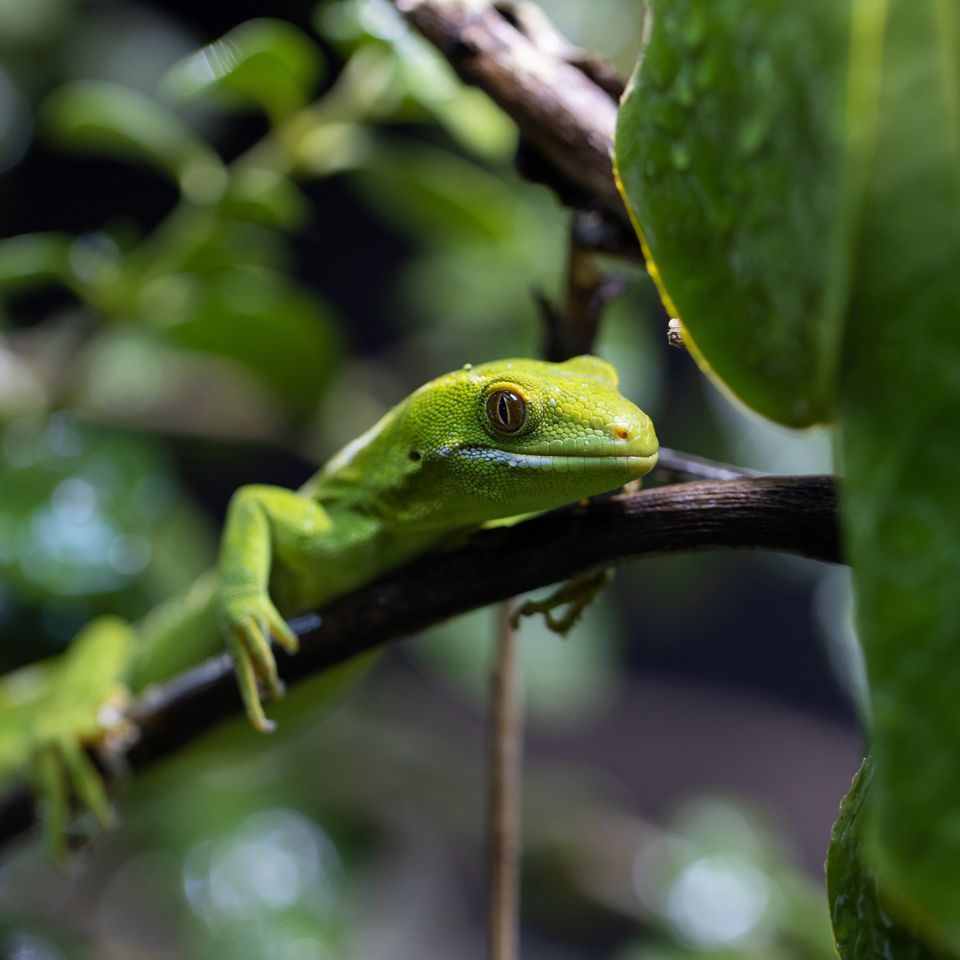
(right top) Common Gecko, (right bottom) Northland green Gecko are a large family of lizards common throughout the warmer regions of the world.

They have large eyes covered by transparent scales that are shed along with the skin. Most reptiles are silent but geckoes are an exception, with New Zealand geckoes chirping or chattering to communicate with their kind.